
The 2026 Encinitas Action Candidate Questionnaire
Encinitas Action invited all six candidates for Mayor and City Council Districts 3 and 4 to answer the same nine questions about the issues, decisions and responsibilities they would face if elected. Our goal was to give each candidate an opportunity to share their perspectives with you on a variety of local issues.
All candidates received the same questions, the same 150–200-word response limit, the same deadline, and the same commitment from us that we would publish their responses verbatim. Each candidate received two reminders after the questionnaire was sent to them.
Three candidates submitted responses; three did not.
We believe voters deserve the opportunity to hear directly from every candidate. We are publishing every response we received, without editing the candidates’ answers for content.
For candidates who did not participate, we have noted that fact in the same space where their responses would have appeared.
The complete questionnaire and candidate responses are below. Readers can judge for themselves whether the questions were fair — and whether a candidate’s decision to answer them or not is relevant to their vote.
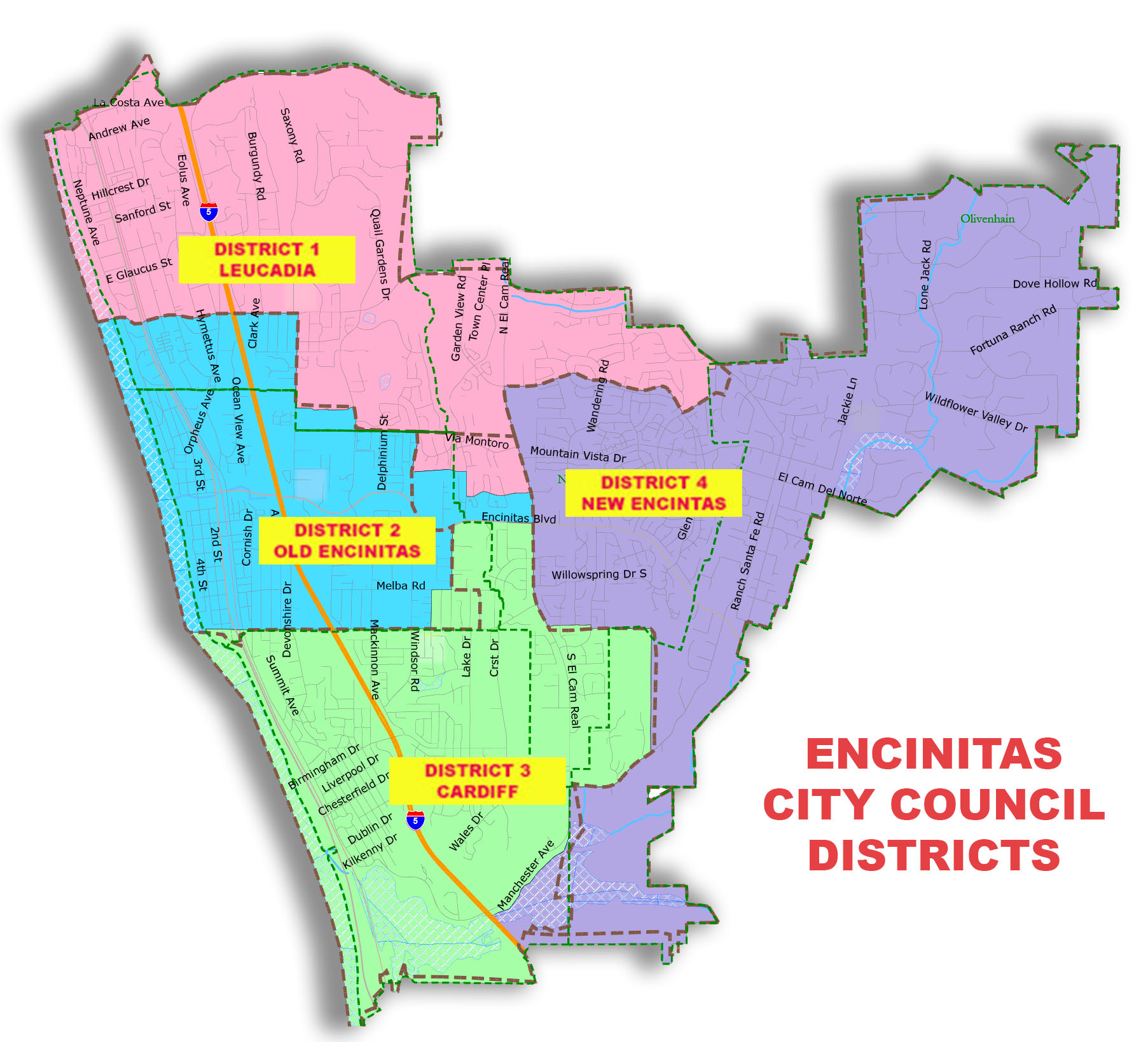
Encinitas City Council District 4 (New Encinitas/Olivenhain)
Marco San Antonio
NO RESPONSE RECEIVED

Brad Lefkowits
1. Vision: What are the three biggest challenges facing Encinitas over the next four years, and what would be your top priority in addressing them?
The three biggest challenges I see are improving public safety and our aging infrastructure, managing growth while protecting the character of our communities, and building greater resilience to environmental threats like wildfire and climate change.
My top priority would be street safety. We have had far too many fatalities and serious injuries on Encinitas roads, including four traffic fatalities in District 4 over the last three years. I want to see meaningful infrastructure improvements, but also a cultural change at City Hall that treats traffic safety as a core public safety responsibility, with staff and resources specifically dedicated to it.
Success over four years would also mean a healthier tree canopy where trees are appropriate, especially in commercial areas where shade can make our streets more walkable, while better managing vegetation in high-fire-risk areas to reduce danger.
Finally, I want to build a record of working with a wide range of Councilmembers and residents, regardless of political affiliation. I want to be known as someone who built bridges and got things done.
2. Housing & Local Control: What approach would you take to balancing the need for housing with preserving the unique character of Encinitas neighborhoods?
I don’t think our choice is between ignoring our housing obligations and accepting unchecked development. Encinitas has to comply with state law, but we should be using every tool available to shape how and where growth occurs, protect existing neighborhoods, and create housing that is actually affordable.
One tool I want Encinitas to seriously explore is AB 787, a state law that allows cities to convert existing market-rate housing into deed-restricted affordable housing. Instead of relying entirely on building more and more units, we can potentially preserve existing structures while creating housing that counts toward our affordability requirements.
I also don’t support spending taxpayer money fighting state housing laws without a realistic path to success. We need to be creative, pragmatic, and focused on solutions that give Encinitas as much control over its future as the law allows.
3. Fiscal Priorities: If declining revenues or rising costs forced difficult choices, which city services or investments would you protect first, and what would you be willing to postpone or reduce?
When budgets get tight, I think local government has to return to its most fundamental responsibilities. Public safety comes first. I would prioritize fire protection and emergency response, law enforcement, safe roads, and the basic infrastructure residents depend on every day.
I also think there is an important distinction between maintaining what we already have and building something new. Streets, parks, public facilities, drainage systems, and other city assets deteriorate when maintenance is deferred, and postponing that work often costs taxpayers more in the long run. Routine maintenance and upkeep would therefore be a high priority for me.
Where I would be more willing to make difficult choices is with new discretionary projects and amenities. There will always be worthwhile things we would like to build, but in a constrained budget we have to distinguish between needs and nice-to-haves.
Before cutting core services or deferring necessary maintenance, I would be willing to postpone new capital projects that aren’t essential to public safety or the basic functioning of the city.
4. Infrastructure: Encinitas has experienced multiple traffic fatalities and serious injuries in recent years. What specific steps would you take to improve safety while maintaining mobility throughout the city?
We need to treat traffic safety as a core public safety responsibility. In District 4 alone, four people have been killed in traffic collisions over the last three years. We should be using collision data, speed data, near-miss information, and residents’ firsthand experience to identify our most dangerous streets and intersections and prioritize investments there.
That means proven engineering improvements, better crossings and visibility, modernized signal timing, Safe Routes to School investments, and crossing guards where needed. Enforcement is also important, particularly for dangerous behaviors like excessive speeding and red-light running, but enforcement alone is not a path to safe streets. We also have to design safer streets.
At the same time, solutions need to fit the neighborhood. What works along El Camino Real may not work on a rural road in Olivenhain. Emergency response, fire access, evacuation capacity, traffic flow, and neighborhood impacts all have to be part of the analysis.
When the data clearly points toward a solution, we should act. Where several reasonable options exist, residents should have a strong voice in deciding what works best for their community.
5. Homelessness: What would you do to address our unsheltered population in Encinitas?
Homelessness cannot be solved by Encinitas acting alone. People move throughout the county, and housing, shelter, behavioral health services, and treatment resources cross city boundaries. Our approach has to be built around regional collaboration.
I support investing in professional outreach that connects people living on our streets with services, treatment when needed, shelter, and ultimately a pathway toward stable housing. We should work closely with experienced service providers and aggressively pursue county, state, and federal resources that can expand those options without placing the entire financial burden on Encinitas taxpayers.
I also don’t believe compassion and accountability are competing values. We should make a serious effort to give people somewhere safe to go and help them get there, while continuing to enforce laws, particularly when someone’s behavior threatens public safety or prevents residents from safely using parks, sidewalks, businesses, and other shared spaces.
The goal should not be simply moving people from one street to another. It should be getting people off the street, connecting them with appropriate help, and maintaining safe and welcoming public spaces for everyone.
6. Leadership: Describe a time when you disagreed with your political supporters or closest allies. What did you decide, and what did you learn?
One example is the debate over the city-owned L-7 property on Quail Gardens Drive. I strongly support creating more genuinely affordable housing, and I understood why people I respect supported using that property for a 100% affordable housing project. But I disagreed.
With substantial development already occurring along that corridor, I felt adding another housing project there, even a relatively modest and affordable one, was a bridge too far. I believe the property presents a rare opportunity to preserve some open space, plant trees, and create a small natural respite along an increasingly busy corridor.
The experience reinforced something I believe strongly: supporting a goal doesn’t require supporting every proposal intended to advance it. Whether the issue is housing, street safety, or our environment, I want to evaluate individual decisions on their merits.
Data and professional expertise should establish the boundaries of responsible decision-making. But when several reasonable choices remain, I believe the people who live in the community deserve a meaningful voice in choosing among them.
7. Judgment: Name one decision made by an Encinitas City Council that you believe was wrong. What would you have done differently, and why?
I believe the Council made a serious mistake when it declined a nearly $4 million state grant that could have expanded homelessness services in Encinitas.
What made the decision particularly frustrating was that the San Diego Rescue Mission, the homelessness service provider selected by this Council, recommended pursuing the funding. Their team has experience operating similar programs in neighboring communities and explained that Encinitas could participate while maintaining meaningful local control.
Homelessness is exactly the kind of challenge where Encinitas needs outside resources and regional partnerships. We cannot simultaneously say the problem is too large for our city to solve alone and then turn away millions of dollars that could help us address it.
I would have pursued the grant while carefully negotiating the details, establishing clear expectations for how the money would be used, and ensuring accountability for results.
We should absolutely scrutinize grants for long-term costs and strings attached. But when experienced professionals recommend a funding opportunity that can help address one of our most difficult problems, turning it down should require an extraordinarily compelling reason.
8. Management: How would you define and maintain a positive working relationship between the city council, city manager, and city staff?
A healthy City Hall starts with respecting everyone’s role. The Council sets policy and establishes priorities. The city manager is responsible for managing the organization and staff. Councilmembers should not be micromanaging individual employees or treating staff as political adversaries when they don’t like the information they receive.
At the same time, respecting professional staff does not mean rubber-stamping every recommendation. Councilmembers should ask difficult questions, challenge assumptions when appropriate, establish clear expectations, and hold the city manager accountable for results.
I also want staff to feel comfortable giving Council their best professional advice, including when that advice is inconvenient or politically unpopular. Good decisions require accurate information, and we undermine that process if employees feel pressured to tell elected officials what they want to hear.
The same principle applies to residents. City Hall should be a place where people can disagree strongly and still feel welcome and heard.
I would try to model that culture myself: be prepared, ask thoughtful questions, disagree respectfully, give clear direction, and then allow professional staff to do their jobs.
9. Hidden Issue: What is one issue facing Encinitas that you believe deserves more public attention?
Stormwater management doesn’t get much attention until something goes wrong, but I think it deserves a much larger place in our infrastructure and environmental planning.
I have spent years working professionally in sustainable landscape design, where stormwater management is often addressed property by property. I have seen how much responsibility and expense can be placed on individual property owners to capture and manage runoff.
I would like Encinitas to think more ambitiously about what we can accomplish at a municipal scale. Strategic stormwater capture and infiltration projects can reduce runoff and flooding, improve water quality, protect our beaches and lagoons, and potentially capture water as a resource rather than simply moving it as quickly as possible toward the ocean.
This is also an area where infrastructure and environmental policy overlap. As our climate changes and extreme weather becomes less predictable, we need systems designed for greater resilience.
Not every solution should be pushed down to individual homeowners. I want us looking for opportunities where larger, coordinated city investments can solve problems more effectively and efficiently.
Thank you for reading!
Upcoming, we’ll publish candidate responses for District 3 and Mayor. There’s a lot at stake in this year’s Encinitas election. We encourage you to learn about the candidates, attend meet-and-greets and debates, and ask questions. An informed electorate makes for a stronger Encinitas.
Stay engaged,
—Encinitas Action