
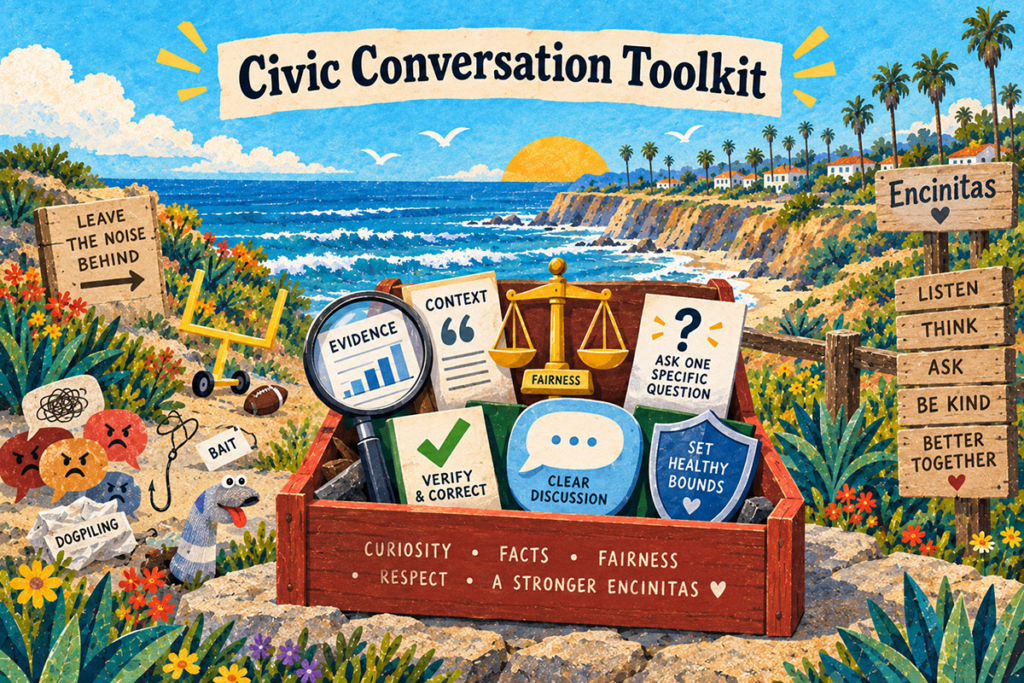
Recognizing fallacies, distractions, distortions, and other ways online discussions go sideways
Last week, we looked at online harassment and how residents can stay engaged without accepting personal abuse as part of civic participation. This week, we’re looking at another way conversations can go off track: bad reasoning, distractions, and tactics that make it harder to discuss the actual issue at hand. If you haven’t yet, please read When Online Civic Debate Turns Personal.
Some of these distractions are honest mistakes anyone can make. Others may be deliberate attempts to provoke, exhaust, or derail. Recognizing the difference can help us ask better questions, focus on the evidence, and keep civic conversations useful.
Logical Fallacies and Trolling in Civic Conversations
A guide for Encinitas residents
Civic conversations work better when we can examine a claim, question its evidence, and disagree without making the discussion personal. This guide explains common reasoning errors and disruptive online behaviors, with practical ways to avoid them and respond. The same standards should apply to all Encinitans, EA supporters, and our critics.
You can use these terms to examine an exchange carefully. Identifying a reasoning error does not automatically prove that a conclusion is false. Explain what is wrong with the argument instead of simply naming a fallacy. Strong criticism, emotion, and disagreement are compatible with a worthwhile discussion.
Common logical fallacies
Anyone can make these mistakes sincerely. Before responding, check that you have understood the claim and apply the same test to your own reasoning.
1. Personal attacks or ad hominem
Using an irrelevant insult about a person to dismiss their argument. (Purdue OWL)
Example: “You are an idiot, so your analysis of the city budget is worthless.”
Avoid it: Identify the disputed fact or inference. A relevant conflict of interest can warrant scrutiny; and an insult does not establish an error.
Respond: “Which figure or conclusion in the budget analysis do you think is wrong?”
2. Guilt by association
Treating someone’s associations as sufficient reason to reject their argument. (Internet Encyclopedia of Philosophy)
Example: “You supported that candidate, so nothing you say about parks deserves consideration.”
Avoid it: Explain any relevant connection with evidence. Political support alone does not make someone’s factual claim false.
Respond: “You can question my endorsement. What is your objection to this parks proposal?”
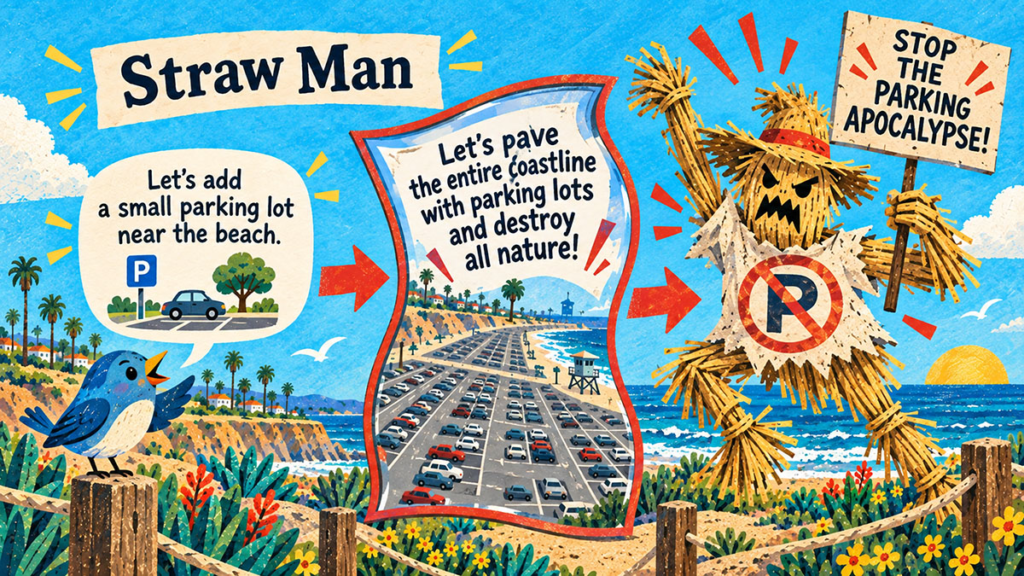
3. Straw man
Replacing someone’s actual position with a distorted version that is easier to attack. (Purdue OWL)
Example: A resident proposes changing one parking lot. A critic replies, “You want to eliminate parking throughout the city.”
Avoid it: Quote the proposal accurately and check your interpretation before criticizing it.
Respond: “The proposal concerns this lot. Which part of that change do you oppose?”
4 . False dilemma
Presenting two choices as the only possibilities when other realistic options exist. (Purdue OWL)
Example: “Either approve this exact street design or accept unsafe streets.”
Avoid it: Consider alternatives, revisions, and combinations of approaches.
Respond: “What other designs could address the safety problem?”
5. Hasty generalization
Drawing a broad conclusion from too few cases or an unrepresentative sample. (Central Arizona College)
Example: “Five people opposed the project in this thread. The entire neighborhood opposes it.”
Avoid it: Describe whose views you actually know. Seek broader evidence before claiming to speak for a neighborhood.
Respond: “Those comments show opposition among those participants. What do we know about the rest of the neighborhood?”
6. Cherry picking
Selecting evidence that favors a conclusion while leaving out relevant contrary evidence. (Central Arizona College)
Example: Calling a program a success based on its best month while omitting the remaining eleven months.
Avoid it: Use a fair time period, explain what you excluded, and address results that challenge your view.
Respond: “Can we see the full year and the same measures from before the program began?”
7. False cause
Assuming one event caused another merely because it came first or the two occurred together. (UNC Writing Center)
Example: “Library visits rose after the new logo appeared, so the logo caused the increase.”
Avoid it: Look for a plausible mechanism and test other explanations, such as changes in hours or programming.
Respond: “What evidence separates the effect of the logo from the other changes?”
8. Unsupported slippery slope
Claiming a first step will inevitably produce a chain of consequences without supporting the links. (Excelsior OWL)
Example: “Allow one evening event in the park and soon there will be concerts every night.”
Avoid it: Explain how each step could occur and consider limits or safeguards. Evidence about a real risk is a legitimate argument.
Respond: “What would cause that expansion, and could permit conditions prevent it?”
9. Whataboutism and appeals to hypocrisy
Deflecting a criticism by pointing to someone else’s wrongdoing instead of addressing the issue raised. (Merriam-Webster)
Example: “Why discuss this misleading campaign post? The other campaign posted something misleading last year.”
Avoid it: Answer the current criticism. Raise relevant comparisons to support consistent standards, without using them to excuse the conduct.
Respond: “We should apply the same standard to both. Is this post accurate, and does it need a correction?”
10. Appeal to popularity
Treating popularity as proof that a factual claim is correct. (University of Hong Kong)
Example: “This post has hundreds of likes, so its claim about the project cost must be true.”
Avoid it: Check the underlying records. Public preferences matter in civic decisions, but “likes” do not verify a cost estimate.
Respond: “Where does that number come from in the project documents?”
11. Misplaced appeal to authority
Treating a prominent person’s opinion as decisive despite a lack of relevant expertise or supporting evidence. (UNC Writing Center)
Example: “A famous actor says this drainage design will work, so we can skip reviewing the engineering.”
Avoid it: Use relevant expertise and examine its evidence and limits. Consulting qualified experts is reasonable.
Respond: “What do the engineers responsible for the drainage analysis conclude, and why?”
12 Shifting the burden of proof
Demanding that others disprove your unsupported claim instead of supplying reasons to accept it. (Internet Encyclopedia of Philosophy)
Example: “The committee secretly changed the totals. Prove it did not.”
Avoid it: Provide evidence for your allegation and distinguish suspicion from established fact.
Respond: “What record supports that allegation? Let’s examine it.”
Common trolling techniques and disruptive patterns
Trolling generally involves deliberate provocation. Some behaviors below can also happen through misunderstanding or poor communication. Look at the pattern and the context; a label cannot establish a stranger’s motives. (eSafety Commissioner)
Requests for evidence, repeated questions about an unanswered point, anonymity, and criticism are not by themselves evidence of trolling. People may reasonably reject an inadequate answer. Respond to the behavior you can describe, and remain open to a specific correction.
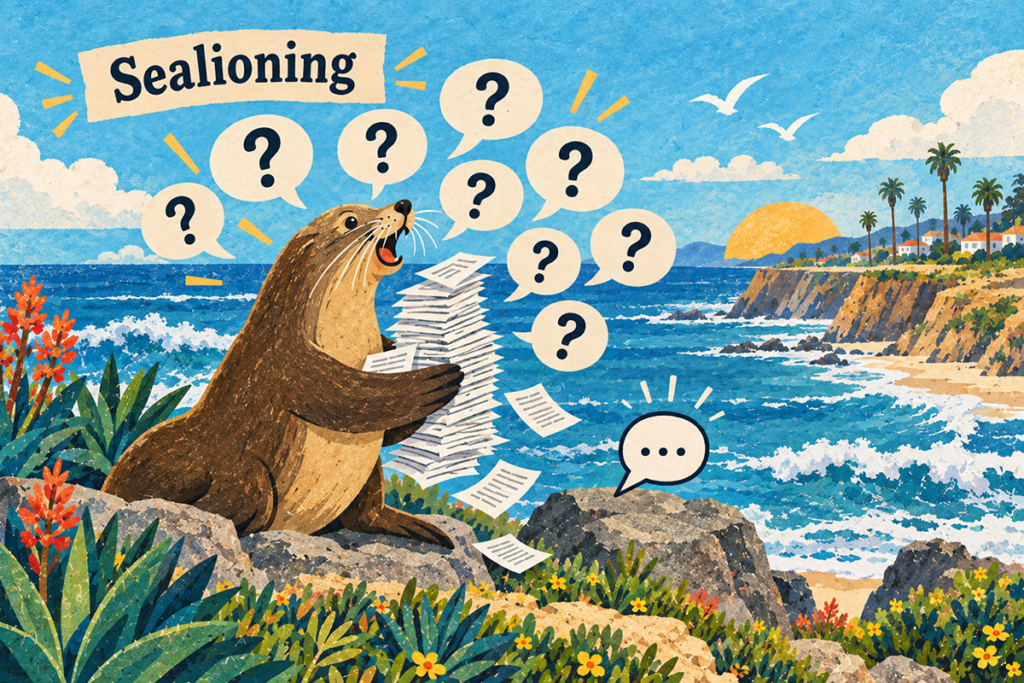
1. Sealioning
Repeated, apparently polite demands for explanations or evidence used to wear someone down rather than engage with the answers. (Merriam-Webster)
Recognize it: The same demand returns after an answer, without identifying what is missing. A sincere request for sources or a substantive follow-up is not enough to establish this pattern.
Respond: “The source and explanation are above. Please identify one specific point they do not address.” If repetition continues, set a limit and leave the exchange.

2. Moving the goalposts
Changing the standard for an acceptable answer after the requested standard has been met. (Cambridge Dictionary)
Recognize it: Someone requests the meeting minutes, then dismisses those minutes and demands a different record without explaining why. New evidence can legitimately raise new questions.
Respond: “This addresses the original question. What new concern are you raising, and why is that record needed?”
3. Gish gallop (Named after Duane Gish, a creationist who frequently used this style in debates against scientists):
Flooding a discussion with weak or misleading claims so quickly that checking them becomes impractical. (National Center for Science Education)
Recognize it: A response introduces a dozen new allegations before the first can be examined. A long, well-supported comment is not automatically a Gish gallop.
Respond: “Let’s start with your most consequential claim and its best source.” Make clear that focusing on one claim does not concede the others.
4. Loaded questions and insinuations
Embedding an unestablished accusation in a question so that answering appears to accept it. (University of Hong Kong)
Recognize it: “When did your group start hiding its real agenda?” presumes concealment. Repeated insinuations can spread an allegation without supporting it.
Respond: “That question assumes concealment. What specific statement or action supports that premise?” Answer any legitimate underlying question directly.
5. Concern trolling
Disguising demeaning attacks as supportive concern or constructive feedback. (PEN America)
Recognize it: Repeated “helpful” remarks undermine a person without identifying an actionable problem. Critical feedback alone does not reveal whether concern is sincere.
Respond: “What specific change do you recommend, and what problem would it address?” Consider concrete suggestions on their merits.
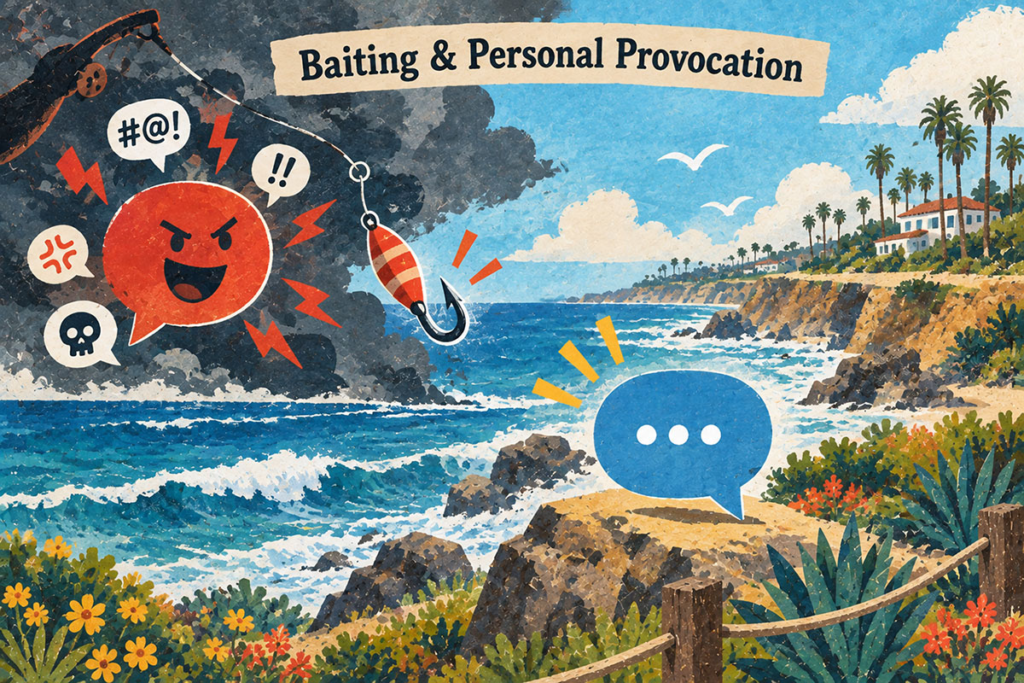
6. Baiting and personal provocation
Using inflammatory remarks or personal taunts to provoke an emotional reaction. (eSafety Commissioner)
Recognize it: Ridiculing someone’s intelligence or appearance because of whom they support, then continuing after they try to return to the issue.
Respond: “I’m available to discuss the proposal. I’m ending this exchange if the personal insults continue.” You can also disengage without replying.
7. Derailing
Repeatedly redirecting a discussion toward unrelated disputes so the original question goes unanswered. This uses the distraction often called a red herring. (Purdue OWL)
Recognize it: A discussion of a crosswalk repeatedly becomes an argument about an unrelated campaign feud.
Respond: “How does that affect this crosswalk decision? If it is a separate issue, let’s discuss it separately.”
8. Stripping away context
Presenting a quote or screenshot without information needed to understand its meaning. (Internet Encyclopedia of Philosophy)
Recognize it: Sharing “I support closing the park” while omitting “during the storm.” A short excerpt is fair if it preserves the meaning.
Respond: “Here is the full statement and its context.” Link to the original and explain the specific omission.
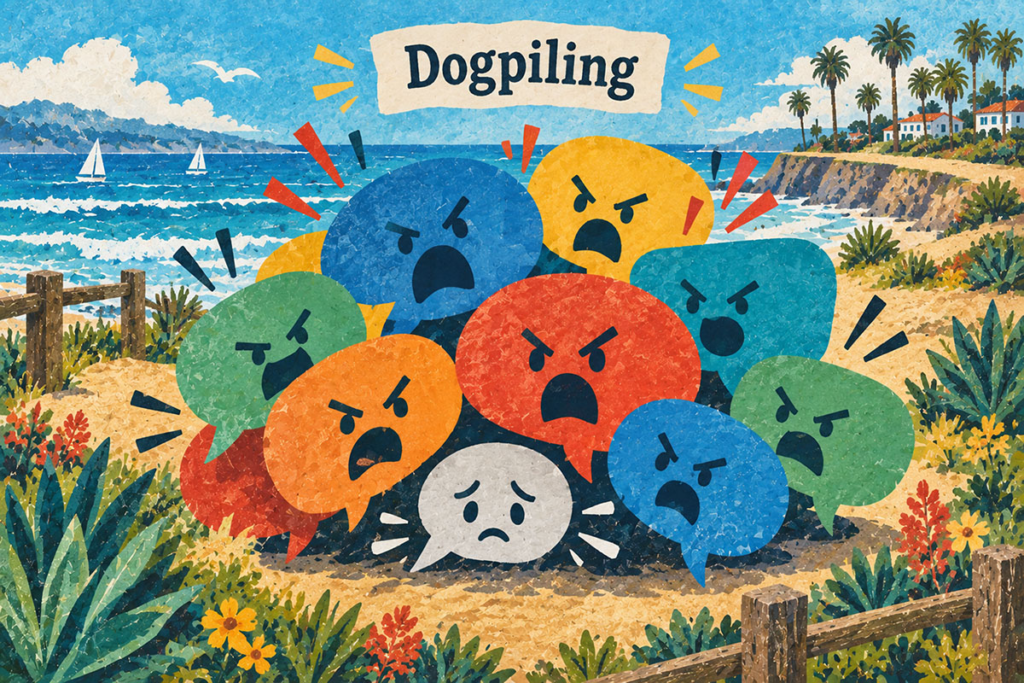
9. Dogpiling
A barrage of abusive messages directed at a person by multiple participants. (PEN America)
Recognize it: Several accounts repeatedly post personal insults at one participant. Many people disagreeing does not itself establish abuse or coordination.
Respond: You do not need to answer each account. Save examples, use reporting or mute tools, and ask a trusted person for help if useful.
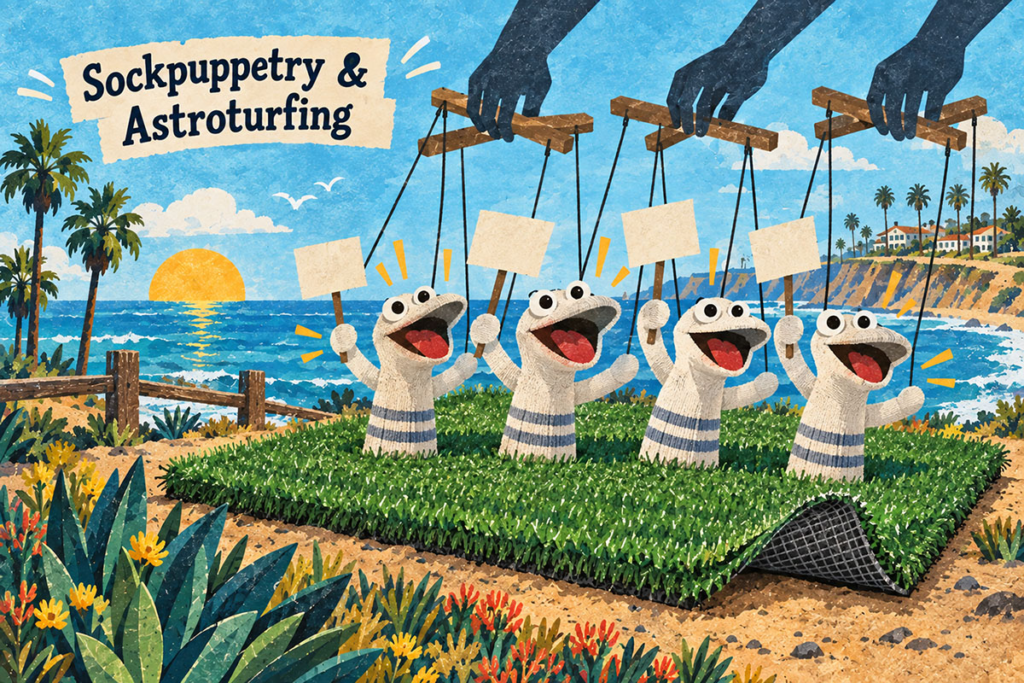
10. Sockpuppetry and astroturfing
Sockpuppetry uses deceptive online identities. Astroturfing conceals coordination to make a campaign appear to be independent grassroots activity. (Merriam-Webster; PEN America)
Recognize it: Several supposedly independent residents are actually controlled by one operator. Anonymity, shared views, or similar wording alone does not prove this.
Respond: Assess the evidence offered. Report documented deception through appropriate channels; avoid public guesses about who runs an account.
Choose a response that helps
Start with a specific question: What claim are we trying to resolve, and what evidence would help? Quote accurately, link to the relevant record, and acknowledge information that changes your view. A short correction may help other readers even when the original commenter remains unconvinced.
You can answer once, set a boundary, or stop participating. Responding publicly can sometimes intensify an exchange, so consider whether it is useful for you. Stepping away does not concede an argument. (PEN America)
If the exchange becomes abusive, save the relevant messages with dates, links, and surrounding context, including your own replies. Use moderation or reporting tools where appropriate, and seek support from someone you trust. (PEN America)
Before posting, ask yourself: Have I represented the other view fairly? Does my evidence support this conclusion? Would I accept the same argument from someone I oppose? A clear correction to our own mistake is part of responsible civic participation.
The point isn’t to win every exchange or attach a label to every bad argument. It’s to make our discussions a little clearer, fairer, and more useful.
That starts with the other person’s argument — but it also means checking our own. If we can represent one another fairly, support what we say with evidence, and be willing to correct ourselves, we’ll have better arguments and a healthier civic conversation.