

The people who cook our meals, teach our kids, care for patients, and keep local businesses open are part of this community. So are young families, retirees and people just starting out. Housing policy should focus on all of them.
What is inclusionary housing, and what does Encinitas require?
The law requires that new private housing projects include affordable homes. Developers build it into the project. The rest of the homes rent or sell at market price. [1]
In Encinitas, projects with 7+ units must make either 20% of base units low-income or 15% very-low-income. These rules took effect May 12, 2022, and older projects may follow earlier rules. [1]
Smaller projects pitch in too. Projects of 6 or fewer units, and residential expansions of 500+ sq ft, must provide an affordable ADU or pay an in-lieu fee (some exemptions apply). [2]
Does this mean everyone is entitled to live by the beach?
No. Having a range of housing options: apartments, smaller homes, ADUs and income-restricted homes provides a realistic chance at living here for people at different incomes. And likely closer to where they work or grew up.
Think about a hospital. Great care takes doctors and nurses. It also takes the people who clean rooms, cook meals, move patients and run the front desk. Ideally, the hospital, and surrounding community, win if all the hospital staff can live nearby.
Can’t people just work harder to afford to live here?
Working hard and earning enough to rent here are two different things.
Do the math. California’s minimum wage is $16.90 an hour in 2026. Full-time, every week of the year, that’s $35,152 before taxes. The standard rule says housing should cost no more than 30% of income. That works out to about $879 a month. Two full-time minimum-wage earners can afford about $1,758. [3]
Now look at Solaris, a new complex on Quail Gardens Drive and Encinitas Boulevard. Today, a 1-bedroom apartment starts at $3,295 a month. To keep that under 30% of income, a household needs $131,800 a year, and that’s before utilities or other charges. [4]
People who worked and saved to buy homes here deserve respect. So do the people whose work keeps this town running. Good housing policy can respect both.
How are affordable rents set?
They’re not a discount off the advertised rent. Restricted rents are based on the program’s income limits and unit size, minus an allowance for utilities the tenant pays. [5]
That doesn’t mean you’ll pay exactly 30% of your income. If you earn well below what the program assumes, the rent can still be a stretch. Ask the property for its approved rent schedule and utility allowance.
Are affordable rent programs the same as Section 8?
No. Inclusionary housing law makes specific homes affordable through development requirements. Section 8 vouchers help eligible households pay rent. They’re separate programs with separate rules and waitlists. Encinitas has a lengthy waitlist (18 years) and closed it to new entrants last summer. [1, 6]
Why not make every new home affordable?
Someone has to pay for land, construction and financing. If restricted rents can’t cover those bills, the project doesn’t get built. A rule that stops construction produces zero homes. There have been proposals to increase private projects’ affordable unit percentages, and those proposals need financial analysis to ensure affordable units are able to be built. That’s why Encinitas commissioned feasibility studies before setting its requirements. [1]
The goal is affordable homes that actually get built, stay affordable and have people living in them.
Who pays for the affordable homes?
In a private project, the developer does. Affordable homes are part of the deal for building, and the lower rents have to pencil out within the project’s budget. Bonus units and other incentives help make that work. [1, 7]
Some projects also get public funding, and some don’t. It depends on the project, so affordable homes aren’t automatically taxpayer funded.
Can developers just pay a fee instead?
Only sometimes. Projects that use the state density bonus, or that sit in the R-30 overlay zone, can’t swap the homes for a fee. Fees that are allowed go into the City’s Affordable Housing Fund. [2]
Do the restrictions go away if the building sells?
No. Encinitas requires inclusionary homes to stay affordable forever, and recorded agreements back that up. Affordable homes for sale come with resale limits, so buyers should read those terms first. [8]
Why does the affordable share look smaller than 20% in many developments?
Under California’s Density Bonus Law, projects that include affordable housing can build extra homes beyond normal zoning limits and get other incentives. [8]
Those bonus units don’t count toward the inclusionary percentage, and neither do ADUs. Example: a project with 100 base units and a 20% low-income requirement would provide 20 restricted low-income homes. Add 50 density bonus units ,and those 20 homes are now about 13% of the 150 total. [2]
What does “low income” actually mean?
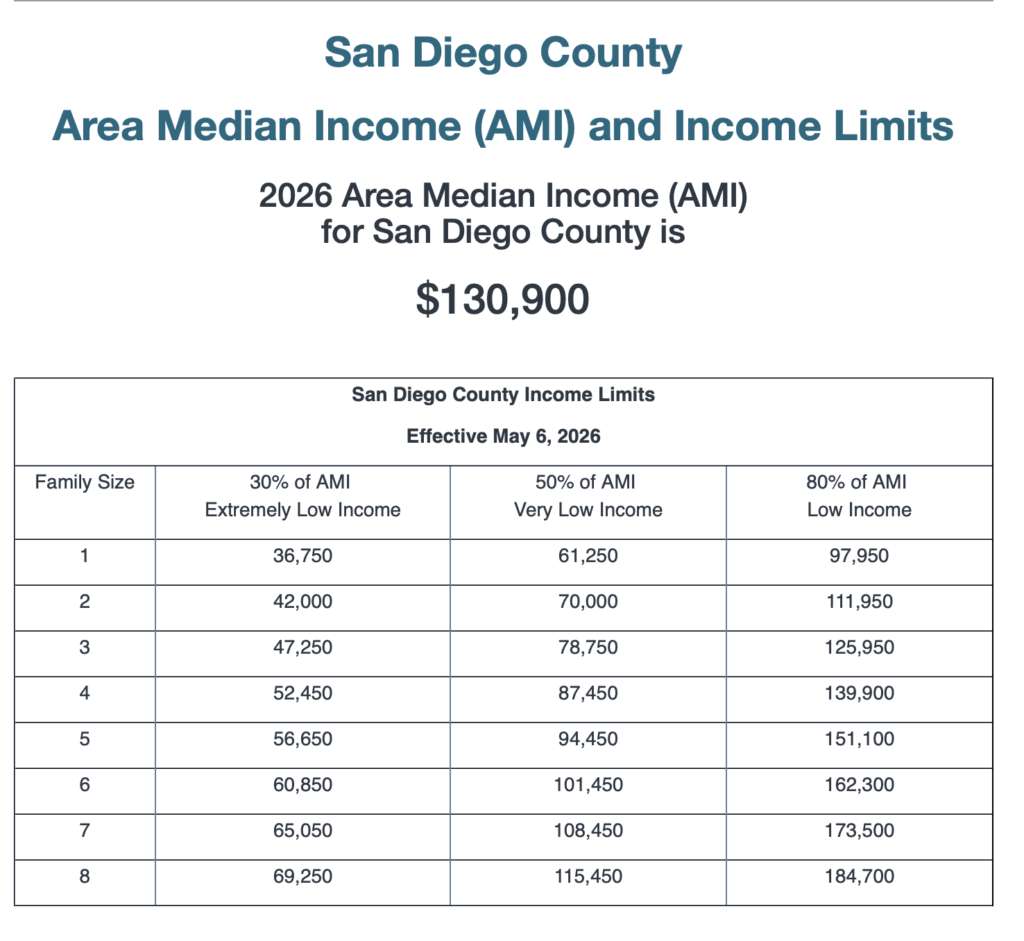
It’s a program category, not a judgment about someone’s effort or worth. Eligibility is based on state income limits for the region, adjusted for household size. Very-low-income is roughly 50% of area median income, and low-income is roughly 80%. The official limits include adjustments, so check the published table. Don’t just do back-of-the-napkin math. [9, 10]
Each project’s affordability agreement sets which income limits apply. [5]
How do I qualify and apply?
You’ll need to verify your income, and the home must be your main residence. [8]
For any property, ask management for:
- Affordable-housing application instructions
- Income limits by household size
- Required documents
- Occupancy and screening standards
- How applicants are selected
- Waitlist status
- All deposits, fees and utility costs
Meeting the income limit doesn’t guarantee you a home, because demand is high.
Can the City of Encinitas do more to support affordable housing?
Yes. We would like to see the City publicly report actual rents, occupancy, eligibility and long-term compliance. And we want the City to develop more tools: dedicated affordable housing and more options for middle-income families.
A town that depends on people’s work should make room for their lives.
Learn more
- Read EA’s housing timeline for the history behind today’s policies.
- Program questions: City Housing staff at 760-633-2723 or [email protected]. [1]
Sources
- City of Encinitas, Inclusionary Housing.
- City of Encinitas, Inclusionary Housing In-Lieu Fee FAQ, Sept. 2025.
- California Department of Industrial Relations, 2026 minimum wage. Budget calculations are EA illustrations.
- Solaris, floor plans and rents, checked Oct. 4, 2026.
- City of Encinitas, Housing resources and current schedules.
- City of Encinitas, Section 8 Housing Choice Voucher Program.
- HCD, Enforcement Authority: Density Bonus Law.
- Encinitas Municipal Code, Chapter 30.41, especially sections 30.41.090–100.
- HCD, Official State Income Limits for 2026.
- County of San Diego, Area Median Income (AMI) and Income Limits Chart, May 6, 2026